
Safety from milk to schnitzel
Brüninghoff secures its integrated production with industry-specific software

Company founder Josef Brüninghoff (left) and his designated successor Jan Roggenkamp prepared the requirements specification.
When people say „German veal“, they usually mean veal from Brüninghoff. The owner-managed company offers a value chain that begins with the milk used in calf feed and extends all the way to sliced and portioned veal. Brüninghoff manages and monitors the security and efficiency of its operations using „winweb-food“, software designed specifically for the meat industry.
Josef Brüninghoff built his first calf barn over 40 years ago and today, with 100 employees and annual revenue of 70 million euros, is a leading specialist in the meat industry. At Brüninghoff in Bocholt, all stages of production from feed and rearing to slaughter and carcass cutting are combined. Operations that integrate two or more stages of production generally offer greater security and facilitate traceability. At the beginning of this chain is the purchase of calves, which are then around 21 days old. The calves come from the home regions of Germany's major dairy farms.
Fully integrated upstream processes
The specialist supplier also purchases the key components for its calf feed from the dairy industry: skimmed milk and whey are purchased in liquid form. Compared with the usual practice of purchasing dried dairy products, this feed offers significant quality and environmental benefits: its nutrient content is better, the feed can be flexibly adapted over the course of the rearing period and there is no need for the highly energy-intensive process of liquefying the dry components. In this way, the Bocholt-based company contributes to environmental protection and eliminates transport distances. The fact that Brüninghoff not only influences the upstream agricultural stage but has fully integrated it is a central pillar of its quality promise.

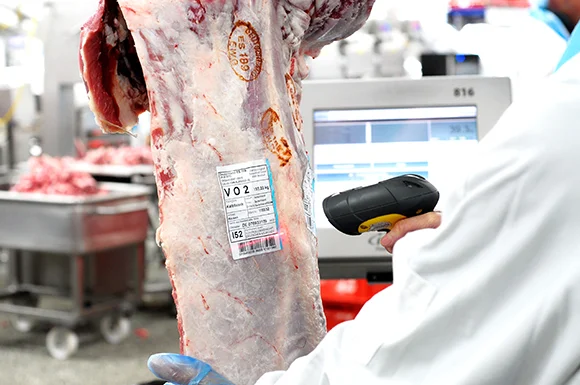
Scanning before carcass cutting (left) ensures traceability, as does the insert label.
Anyone given a tour of the slaughtering and cutting facility in Bocholt’s industrial area by Jan Roggenkamp experiences specialist expertise – from milk to veal cutlets. Roggenkamp, who is preparing to take over the company as a member of the management team, likes to explore every topic in depth. This is the best way for him to explain what makes the company unique: This includes the 60 calf barn sites where contracted farmers raise the calves according to Brüninghoff’s specifications. The barns belong to the farmers. The calves – between 200 and 4000 per farm – are owned by Brüninghoff from the outset. The journey from any of these barns to the slaughterhouse takes no calf longer than one hour. This specialist expertise shapes every area of the company. There is the specialization in German veal (DDDD =born, raised, slaughtered and cut in Germany). There is the specialization of the employees – for example, the cutting department employs only the company’s own staff, many of whom have been there for over 25 years. And there is the specialization in „veal to order“, as every conceivable customer requirement is met, including specifications for the cutting or packaging of individual cuts.
Software specialist rather than generalist
This specialist approach also characterizes the company’s procurement. When deciding to invest in new enterprise software, Josef Brüninghoff and Jan Roggenkamp narrowed down the providers and concluded “We do not want a software partner that has to focus on three or four other industries besides meat”. They had learned from their experience with the previous software provider, having previously used a solution from a generalist. Such providers know a little about everything, but nothing specific about the meat industry. The specialist knowledge that Roggenkamp demanded covered issues such as traceability and quality assurance, as well as costing and pricing. The guiding principle was: “We are industry specialists ourselves and we also want to work with an industry specialist in the field of software”.
We are industry specialists ourselves, and we also want to work with an industry specialist for our software.
When selecting potential software providers in 2009, Winweb from Aldenhoven had a head start. This was because Brüninghoff had already needed specialized software eight years earlier – to manage and monitor calf rearing. Since then, calf rearing has been managed using a specialized module from Winweb's industry-specific software. Yet despite this initial trust, Jan Roggenkamp first drew up a requirements specification. This means: He did not evaluate the available software solutions to determine which one was best suited to his company, but instead specified to the software vendors what his new business software needed to be able to do. „Software is ‚soft’, after all, so it must be adaptable too“, he says.

All conceivable customer requirements regarding cut specifications or packaging are met
Requirements specification for the new software
Jan Roggenkamp asked various vendors to name reference companies , visited them and asked about their experiences. And ultimately, as with any investment, there was of course a budget: There were target prices, both for the purchase and for ongoing costs. This cost ceiling ruled out some vendors from the outset whose prices were ‚beyond all reason’. The Brüninghoff-manager welcomed the fact that the „very largest vendors“ were therefore no longer on the shortlist for another structural reason: „It was also important to me to have a partner on an equal footing. In day-to-day business, I want to reach the right experts directly by phone and not end up in a call-center“.
We can do it all with veal. And Winweb can do it all with meat software.
Four years have passed since Jan Roggenkamp wrote his requirements specification for the new business software, and the system „winweb-food“ has been in successful use for three years. The overall verdict is unequivocal: „We can do everything when it comes to veal. And Winweb can do everything when it comes to software for the meat industry.“ This positive assessment is also based on the solution of special requirements, such as the ability to manage three addresses for each customer as standard: one for the delivery location, one for the recipient of the goods, one for the invoice recipient. Another unusual requirement was the connection of a new laboratory device for testing the quality of the milk used to feed the calves. This piece of dairy equipment now automatically provides Brüninghoff’s buyers via „winweb-food“ with the data needed to assess milk deliveries, which in turn serve as the basis for pricing in a way similar to a quality grade.
What Winweb means by „ease of use“ was already evident at Brüninghoff during the initial phase. Jan Roggenkamp: „Throughout the implementation of the program, there was not a single day on which Winweb-employed staff needed to be here at our premises. With support from Aldenhoven, we were able to connect the scales and other hardware ourselves“. The system, which was virtually intuitive for the employees at Brüninghoff- even when it was first implemented, is also designed to allow employees to work flexibly across different roles. The junior managing director sums it up: „If someone handles purchasing , at our company they must also be able to handle sales . Anyone who can enter a purchase order must also be able to enter a sales order. That is possible when the software has a logical and symmetrical structure.“
Focus on processing and wholesale trade
The software company Winweb is a provider specializing exclusively in the meat industry. This focus on meat processing and wholesale trade offers practical benefits for users:
• Everything included. The software covers all the operational areas that a meat processing company or wholesale business may have – from livestock purchasing and slaughter, procurement, carcass cutting, and production through to sales and branch monitoring.
• Easy to get started. The software was designed so that commercial and operational staff can quickly learn to use the system without specialist IT training. It is fast and easy to use and does not require an in-house IT department.
• Everything securely connected. The integration of peripheral devices from different manufacturers throughout the entire process chain is standard. Winweb is familiar with the technology its customers use for weighing, scanning, and labeling.
• Everything calculated with confidence. Technological operational reliability is complemented by financial security – users can see the contribution margin achieved for every customer and item, every batch and delivery. This provides a clear view of cost of goods sold, gross profit, and branch performance.
• Everything safely traced. The solution grows in line with the requirements of legislators, retailers and consumers for
tracing a meat product back to the live animal.
Production planning, quality assurance and origin verification go „hand in hand.
Images: Brüninghoff/Winweb, Annie Spratt / unsplash
Published in Fleischwirtschaft
Winweb Content Team
More articles on this topic

